
 Fast & Efficient Delivery, learn more
 Expert Advice, we’re here to help
 All Major Cards Accepted
What Is a Euro Box? Types, Uses and Why They’re So Popular
Euro boxes are reusable plastic storage containers designed around compatible sizes, which makes them particularly useful in warehouses, factories, stockrooms, assembly areas and distribution environments.
That sounds straightforward, but the range can quickly become confusing. Solid, vented, open-front and heavy-duty Euro boxes may look broadly similar, yet each is better suited to a different type of storage or handling task.
The easiest way to understand them is not to start with “Which Euro box should I buy?” but
“What do I need the box to do?”. Once that is clear, the different types become much easier to understand.
Quick Summary
Euro boxes are popular because they provide a practical, repeatable way to store, organise, stack and move stock.
- Solid Euro boxes are useful for general storage and keeping loose contents contained.
- Vented Euro boxes allow airflow through the container.
- Open-front Euro boxes make stock easier to access while boxes remain stacked.
- Heavy-duty Euro boxes are designed for more demanding industrial storage and handling.
- Lids can be useful, but they are not always necessary.
- Attached-lid distribution containers may be a better option where boxes regularly move between locations.
The right choice depends on what you are storing, how often you need access, how the box will be handled and whether it is mainly being used for storage, picking or transport.
What exactly is a Euro box?
A Euro box is a reusable plastic storage container designed around modular dimensions.
That means different sizes can work together more predictably than a collection of unrelated storage boxes.
A common footprint is 600 × 400mm. This aligns with the modular dimensions referenced in ISO 3394, the international standard covering dimensions for rigid rectangular transport packages. Euro boxes are also available in a variety of footprints, heights and capacities to suit different storage systems and applications.
If sizing is the main question, our dedicated Eurobox Dimensions Guide covers common sizes such as 400 × 300mm, 600 × 400mm and 800 × 600mm in more detail.
For this guide, the more important question is why Euro boxes are used in the first place.
Why are Euro boxes so popular?
One of their biggest advantages is that they make storage more predictable.
Compatible boxes can be arranged efficiently on shelving, racks, workstations or pallets, helping businesses make better use of the available space.
But their popularity is not just about dimensions, 3JC sees Euro boxes being used for:
- general storage
- order picking
- assembly-line components
- stock movement
- transporting products between sites
Customers range from clothing wholesalers and events companies to factories and logistics businesses.
That variety is important because it shows why there is no single “best” Euro box. A box used beside an assembly line has a very different job from one travelling between warehouses.
What are the main types of Euro box?
The easiest way to compare Euro boxes is to focus on what changes about how they are used.
Solid Euro boxes
Solid Euro boxes have enclosed sides and bases.
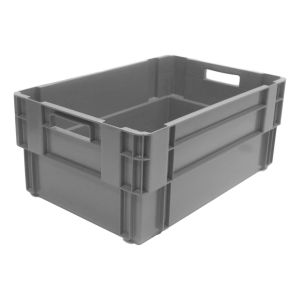
They are a straightforward option for general storage where keeping loose products and components contained is important.
They can work well for:
- stockroom storage
- components
- packaged goods
- workshop items
- general warehouse stock
You can explore the current Standard Euro Boxes range for the main available options.
Some Euro boxes can also be designed to stack when in use and nest when empty, helping reduce the space taken up by unused containers.
That is why it is worth checking the individual product specification rather than assuming all Euro boxes behave in exactly the same way.
Vented Euro boxes
Vented Euro boxes have openings in the sides, base or both.
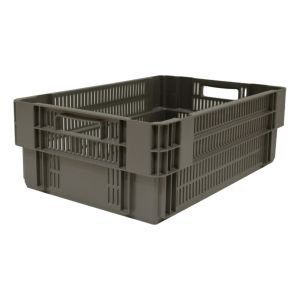
The practical difference is airflow.
Where stored products benefit from ventilation, a vented container may make more sense than a completely enclosed box.
Solid is not automatically better than vented, or vice versa. The correct choice depends on what is being stored and the environment in which the box is being used.
Open-front Euro boxes
Open-front Euro boxes allow the contents to be accessed while the boxes remain stacked.
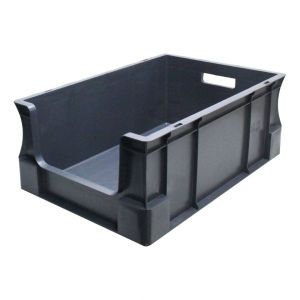
This makes them particularly useful for order picking and assembly environments, where staff may need regular access to components or products without moving the containers above.
For example, someone picking small items repeatedly from a warehouse location can reach directly into the box rather than unstacking containers every time.
The same design may be less useful during transport because the open front provides less containment.
For order-picking applications, also look at the dedicated Picking Boxes range.
Heavy-duty Euro boxes
Heavy-duty Euro boxes are designed for more demanding industrial environments.
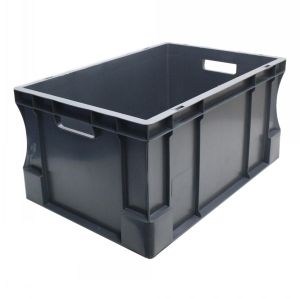
They may offer stronger construction, reinforced sides or more robust stacking features, depending on the individual product.
They can make sense where the container will experience heavier or more frequent handling.
You can explore the Heavy Duty Euro Boxes range.
However, heavy-duty does not automatically mean better. If the stored items and working environment do not require the extra construction, a standard Euro box may be perfectly suitable.
The aim should be to match the box to the job rather than simply choosing the most substantial option available.
Do Euro boxes always need lids?
No. This is one area where customers can sometimes buy more than they actually need.
When Euro boxes are stacked, the box above can effectively act as a cover for the container underneath.
In that situation, a separate lid may offer limited additional benefit. Lids become more useful where:
- boxes are used individually
- protection from dust is important
- contents need additional enclosure
- boxes are being handled or moved separately
When might another container be better?
Euro boxes are versatile, but they are not always the right solution.
Where containers regularly move between locations, an attached-lid distribution container can sometimes be more practical.
These containers are often designed to stack when closed and nest when empty, which can be useful where large numbers of empty containers need to be returned or stored. For example, the Attached Lid Distribution Container. This does not mean Euro boxes cannot nest, some can.
The best comparison is based on the complete job:
- how often the box is transported
- whether it needs an integrated lid
- how it will be stored when empty
- how frequently the contents need to be accessed
What size Euro box do you need?
Start with what you are storing. Think about:
- the physical size of the items
- the quantity being stored
- how heavy the full box will become
- how often somebody needs to lift or access it
- where the box needs to fit
Choosing the largest box available is not always the most practical answer.
A container may technically hold more stock but become awkward to move once full. The Health and Safety Executive’s manual handling guidance also stresses that handling risk depends on factors such as the load, task and frequency of movement rather than there being one universal “safe” weight.
How does 3JC help customers choose?
The starting point is understanding what you actually want the Euro box to do. We regularly look at factors such as:
- what is being stored
- how much is being stored
- how frequently access is required
- whether ventilation matters
- whether the box needs a lid
- whether it will remain in storage or travel between sites
- whether open-front access would make picking easier
The answer might be a standard solid Euro box, a vented version, an open-front picking box, a heavy-duty container or even a different storage solution altogether.
You may contact the 3JC team for clarity and we can help you compare the available options.
Frequently Asked Questions
What are Euro boxes used for?
Euro boxes are commonly used for general storage, order picking, assembly work, organising components and moving stock or products between locations.
What is the difference between solid and vented Euro boxes?
Solid Euro boxes have enclosed sides and bases, while vented boxes contain openings that allow air to circulate around the contents.
Do Euro boxes need lids?
Not always. If compatible Euro boxes remain stacked, the container above can provide some cover. A lid is more useful when boxes are used individually or where additional protection from dust or handling is required.
Can Euro boxes nest as well as stack?
Some can. Euro boxes vary by design, so some models may stack when in use and nest when empty, while others are primarily designed around stacking. Always check the individual product specification before choosing.